On 12 Sept 2025, the Hawai’i Supreme Court issued its decision in Hilo Bay Marina, LLC and Keaukaha Ministry LLC, v. State of Hawai’i; Board of Land and Natural Resources, State of Hawai’i. The state had imposed a deed restriction that if a landowner did not use the land for “church purposes only,” it would revert to the state. The court found that was state action advancing religion which is not allowed under the state Constitution. It also involved the state in religious business because the state would have to monitor the “church purpose only” clause. The state Supreme Court said they did not have to follow the U.S. Supreme Court (Cult) since it’s their state constitution and it has stronger protections.
In August of 2025, the Maricopa County Superior Court released their 114-page decision in Glendale Elementary School District et al v. State of Az et al, the newest case in a long series of cases about the terrible school funding in Arizona. This case has gone on for years with massive work by attorneys and thousands of pages of documents, exhibits, and arguments. A two-week trial was held in May 2024. This lawsuit challenges the constitutionality of Arizona’s system for funding the capital needs of Arizona’s K-12 public schools – again.
We’re about to find out what happens when the rights of the church are placed above the rights of the state… in this review of recent legal cases and religious lawsuits that impact separation of church and state
On May 23, 2023, parents and two religious educational institutions filed a lawsuit against the state of MN over their policy regarding post-secondary enrollment options allowing high school kids to enroll in college courses and get simultaneous high school and college credit.
One of the religious educational institutions that sued is the largest provider of PSEO in the state. In the previous year, Northwestern got $33 million and Crown $5 million.
Please join us on October 11 in Tucson for Ask an Immigration Attorney, an informal discussion with legal experts to answer your concerns and questions about immigration law and attacks on the migrant community in Arizona. *No questions about individual cases please!*
Where: RSVP for address – near Broadway/Alvernon in Tucson. (We will send registered guests the location the day before the event)
When: October 11 from 5:30-7:00pm
What: BYOB – light refreshments provided
Who: Our hosts are Executive Director Jeanne Casteen and Development Director Eddie Chavez Calderon. Our guest speakers are:
This is Southern Arizona’s chance to meet Secular AZ’s Executive Director and Development Director, AND discuss the current ICE situation in Greater Tucson.
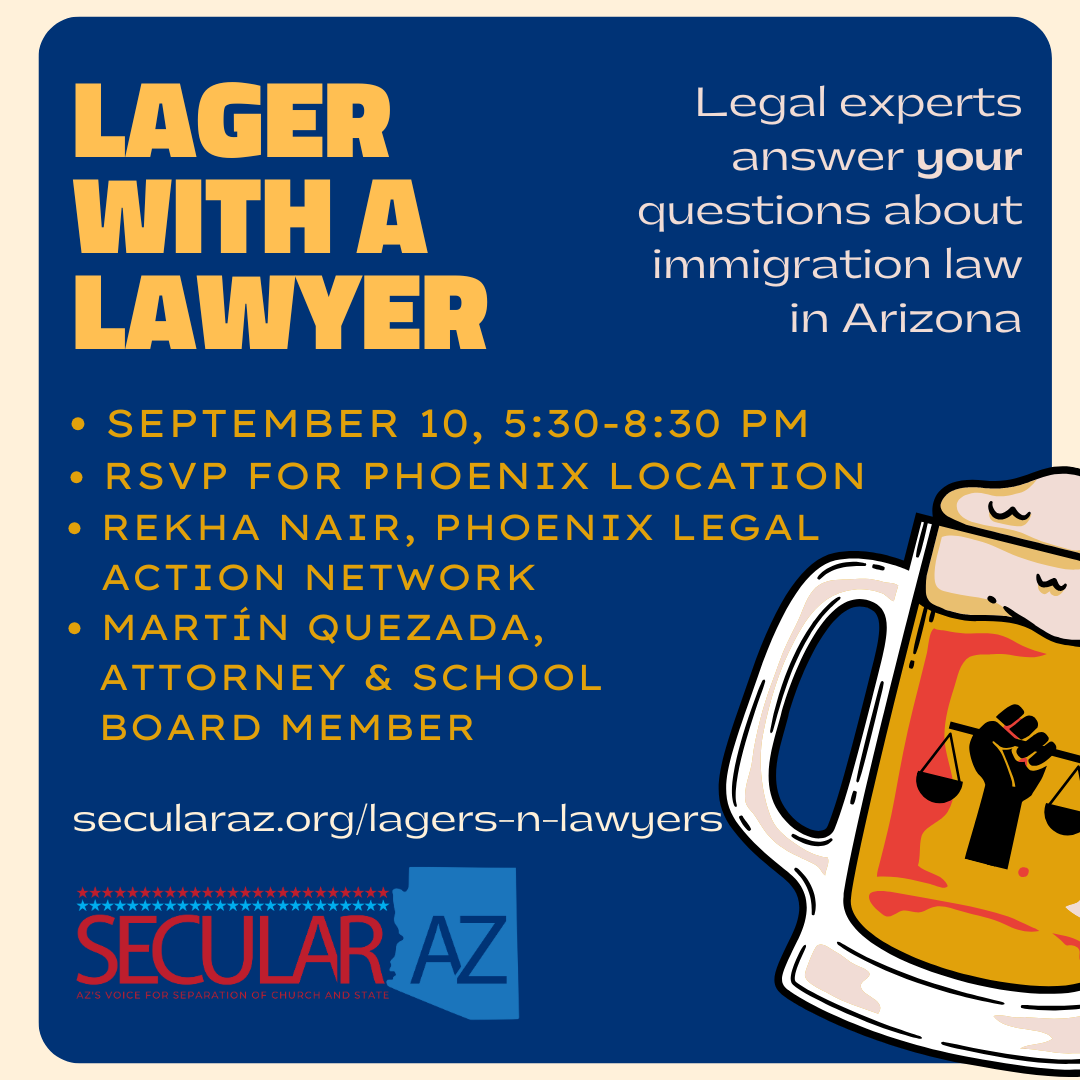
Please join us on September 10 in Phoenix for Lager with a Lawyer, a series of informal talks with legal experts to answer your concerns and questions about what is happening with immigration law and attacks on the migrant community in Arizona. *No questions about individual cases please!*
Rekha Nair, Executive Director of the Phoenix Legal Action Network
Martín Quezada, attorney and school board member
Though we are not charging you for what would be a $300/hour legal consultation, we humbly ask that you will level up to Legal Beagle ($10) or Courtside ($50) or Supreme Cult ($100) or Chief (fighter for) Justice at the $500 mark.
We will send the address two days before the event to those who RSVP
Our guest panelists:
Rekha Nair is a first generation immigrant and Phoenician. She is a proud graduate of Arizona State University and the University of Pennsylvania Law School (L’12). She is a former math teacher, public defender, and PLAN and Trans Queer Pueblo board member and has been fighting to protect and expand the rights of immigrants and their families in Arizona since 2014.
She became Executive Director of PLAN in July 2021. She loves chocolate and speaking Spanish; she abhors injustice and most fruit.
Martín Quezada has dedicated his life of public service to fighting for an Arizona that works for all of us, not just a wealthy few. He is most widely recognized as “The People’s Senator” after serving over 10 years in the AZ State Legislature. He was appointed to the State House of Representatives in 2012 and elected to a full term later that year. In 2014 he was elected to the State Senate and was re-elected to the Senate in 2014, 2016 & 2020. In 2022, he was the Democratic nominee for the office of AZ State Treasurer.
In 2010 he was first elected to the Pendergast Elementary School District Governing Board. He was re-elected in 2014, 2018 and 2022 and served as Board President in 2013, 2014, 2018 and 2023.
Martín is also equally effective as a people’s servant. A native Arizonan, born to working class parents in the Maryvale community of West Phoenix, he has served as a judicial law clerk to Judge Patricia A. Orozco on the AZ Court of Appeals, a research analyst in the State Legislature, a justice of the peace pro tem, an educator at ASU’s College of Law teaching courses on contracts, business organizations, family law and immigration law and he served in Governor Hobbs’ cabinet as the Director of the AZ Registrar of Contractors, a state agency dedicated to protecting the health, safety and welfare of the public by promoting quality construction by AZ contractors.
This is all in addition to his role as a people’s attorney where he’s practiced criminal defense, domestic relations, civil litigation, immigration and election law as a member of his own law firm, The Law Office of Martín J. Quezada, PLLC or as an of counsel member of Desert Bloom Immigration (immigration law) and Thunderbird Law Group (labor law). He now serves as the Attorney and Civil Rights Director for the Council on American-Islamic Relations, Arizona Chapter.
Due to unforseen circumstances, this event has been cancelled. We will reschedule; stay tuned.
Please join us on July 9 in Phoenix for Lager with a Lawyer, a series of informal talks with a lawyer or two to answer your concerns and questions about what is happening with immigration/attacks on migrants in Arizona and the U.S. *No questions about individual cases please!*
Meet us at: Joy Lush Club, 24 W Cameback Rd Stes D&E, Phoenix.
When: July 9, 5:30-8p
Tonight, our guest speaker is Ayensa I. Millan of CIMA Law Group, PC.
This special event is limited to Secular AZ members; though we are not charging you for what would be a $300/hour legal consultation, we humbly ask that you will level up to Legal Beagle ($10) or Courtside ($50) or Supreme Cult ($100) or Chief (fighter for) Justice at the $500 mark.
In 2023, Secular AZ spoke up against the reading of religious scripture at Peoria Unified School District board meetings by board member Rooks, who filed a lawsuit against the district. This week, the court ruled against Rooks.
The HHS recently replaced a dangerous rule on conscience rights for medical workers from 2019, with a New Final rule aiming to remove aspects of it that encouraged discrimination while streamlining the complaint process. Continue reading →
by Adriana Lujan-Flores, Secular Communities for AZ Legal Intern
On November 25, 2020, the U.S. Supreme Court ruled to stop New York Governor Andrew Cuomo from limiting church capacity in areas with high concentrations of COVID-19 cases. Executive Order 202.68 imposed a 10-person occupancy limit on “red zones” and a 25-person occupancy limit on “orange zones”— areas determined to be hot spots for the deadly virus. The 5-4 decision ruled that Cuomo’s executive order violated the free exercise clause of the First Amendment by allowing certain essential businesses (such as shops and laundromats) to operate with a higher occupancy than religious organizations.
The majority opinion insists that there is no reason to assume that churches and synagogues are more dangerous than other businesses, and that attending religious services from home is “not the same as personal attendance.” Justice Gorsuch’s concurrence belabors the point by repeatedly claiming that allowing liquor stores and bike shops to operate at a different standard from churches and synagogues is “treating religious exercises worse than comparable secular activities.”
However, liquor stores and bike shops are in no way comparable to churches and synagogues. As Justice Sotomayor points out in her dissent, people do not gather in large groups for over an hour in stores the way they do in houses of worship. Furthermore, Cuomo’s executive order actually treated religious organizations more favorably than comparable secular events such as concerts and cinemas, which have been closed entirely.
In fact, the only reason the order even mentions houses of worship is to give churches preferential treatment by allowing them to be open to the public at all. Sotomayor also points out the Court’s hypocrisy in considering applying heightened scrutiny to this case, but not to the President’s “Muslim ban” in Trump v. Hawaii,which prevented Muslims from certain countries from entering the United States.
The free exercise clause of the First Amendment prevents the government from prohibiting the exercise of religion. However, the right to freedom of religion doesn’t give every religious group a free pass to ignore the law. Courts have upheld legislation that burdens the free exercise of religion if there is some threat to public safety, peace, or order. Restrictions on large gatherings during a pandemic are intended to protect the public from a deadly virus that spreads through close contact from person to person.
Justice Breyer notes in his dissent that the uncertain nature of COVID-19 creates a strong argument for the state to take actions to curb the risk of spread. But the majority of the Court rejects this as a compelling reason to restrict church capacities — essentially ignoring warnings from public health experts — because there is not evidence that these specific churches have already increased the spread of COVID-19. The court seems to suggest a reactive approach to the pandemic by not allowing local governments to take preventive measures until it is too late.
Three weeks after the opinion in Roman Catholic Diocese of Brooklyn v. Cuomo was issued, the country is already seeing the decision’s effects. On December 15, the Supreme Court accepted an appeal from a Colorado church fighting a 50-person occupancy limit, despite the fact that the restriction had already been lifted by the governor. On the same day, the Court granted a similar appeal by a New Jersey church. Both cases relied on the precedent set in Cuomo’s case, and it is likely that other organizations will use the case to fight pandemic-related restrictions going forward.
Notably, the 10-25-person capacity limitations were no longer in effect in New York by the time this case reached the Supreme Court, so the injunction will have little direct impact. Nonetheless, the Court decided to issue an opinion anyway, just in case the restrictions are reinstated.
This case is just an example of religious organizations testing how far the Court will go to allow churches to act above the law. Even though houses of worship were given preferential treatment under Cuomo’s executive order, that was not enough for an entity that is used to having absolute power.
The ABA sponsored a 90-minute seminar on October 8 on the Establishment Clause of the First Amendment. Marc Stern, general counsel of the American Jewish Committee, moderated the presentation.He began by outlining the two strands of Establishment Clause jurisprudence: a strict prohibition against aiding religion versus accommodation to religion.
The first speaker was Thomas C. Berg, a professor of law and public policy at the University of St. Thomas in Chicago. He said the Establishment Clause is declining in both a good and bad way.The good way, as he believes, is that government money can now go to religious operations. Repeatedly he trumpeted the Espinoza v. Montana mandatory school funding decision as allowing impoverished parents to choose which schools to send their children to. That is a complete red herring, as most students in private and religious schools come from well-off families, not the poor, and “school choice” is code for school discrimination as the South developed it after Brown v. Board of Education mandated integration.
To Enforce the Establishment Clause is Not Discrimination
What listeners in the chat pointed out is that the religious want “religious choice” to pick a religious school with taxpayers paying for it, but they don’t want women to have “religious choice” to use contraception, or have an abortion and have the government or even insurance pay for it.
The bad way was an increase in allowing the government itself to pray and display religious symbols as in the Town of Greece v. Gallowaycity council invocation case and Bladensberg cross case. That was about the extent of our agreement.
I understand they don’t want to pay for my abortion; I don’t want to pay for your child to go to religious school either.They don’t want to pay taxes, but they want tax money. They want to be able to discriminate, but they don’t want to be discriminated against.They want to have their cake and eat it too.
Steven Green, professor of law and director of the Center for Religion at Willamette University in Oregon, was the next speaker.He noted that this struggle has been going on since the Great Society began giving money to private groups to engage in government welfare programs.The trend has accelerated. Green argued that we can accommodate religion, but when it is a zero sum game and a burden is transferred to another person, that we cannot do (e.g. the Hobby Lobby case was wrongly decided as“religious personhood” of a business is a complete farce and the “burden” was transferred to someone else, the women employees locked out of health care).
Green said the Establishment Clause has been turned on its head, especially in Espinoza; i.e. the original intent — that government should not fund religious activity — has come to mean that government cannot discriminate against religious activity in funding. But to enforce the Establishment Clause is not discrimination.Religions get benefits that others don’t, such as:
paying no tax
filing no donation/income documents
getting breaks on zoning, parking, drinking, dietary practices, running businesses, and other regulations
They want to continue to get all those benefits that other non-profits don’t, and get the money too.
Green also argued that the expression clause has also been eroded in the last 10 years. He pointed out that we cannot look at a frozen point in time 240 years ago and identify all the history impacting the actions nor understand the motivations. Also, we have to allow for changes in attitudes and perceptions.
Disestablishment (states having a state religion) disappeared in 12 years.That was a total change in attitude. At the time of the First Amendment, over 90% of Americans were Protestants. Now less than 50% are. We cannot cherry-pick certain speeches or laws and use those as an analogy. No social impetus has driven the court to support religion. Usually social trends lead the court; in this case, the court is trying to create a trend to take us backward to some previous time.
Holly Hollman, general counsel and associate executive director of the Baptist Joint Committee, spoke next.She was clear that their history is one of supporting separation of church and state. Our country is envied for its tolerance and lack of discord over religion. These religious decisions are destroying that balance.They believe that keeping government and religion separate benefits religion; it is not hostile to it. Separation avoids government financial entanglement, which was the main purpose. We have gone from no funding of churches to mandatory funding of churches in the Trinity Lutheran case.Hollman argues that this trend is harming churches by decreasing their independence, by encouraging attacks on churches for the special treatment they now get (why should churches be exempt from taxes when they get tax money etc.), and discourages fairness to all religions, which leads to intolerance and the weakening of religious freedom for everyone.
Asma Uddin, from the Religious Freedom Center at UCLA, was the last speaker.She claimed that the main purpose of the Establishment Clause was to expand volunteerism, a point Green completely disagreed with.She claims that the court in Espinoza simply expanded religious choice (with no consideration for those who chose no religion). Uddin reiterated the holdings of a bunch of cases, read some list written by a professor, and repeated slogans like “leave religion alone” and “religious choice,” but really had not much to add to the discussion.
When You are Used to Being Dominant, Fairness Feels like Oppression
Marc Stern remarked that society is becoming less religious by the decade, and asked how does this or should this influence the court. Green pointed out that the court is seeking to return to an earlier place because white Protestants are concerned about losing their privileged status in society.They realize they are being deposed from their positions and so they feel attacked. When a group has been in control and held power and then equality is imposed, that group feels they are being treated unfairly.
Studies have been done in school where teachers called on boys disproportionately.The teachers didn’t believe it until they watched the video tapes.They thought they were calling on girls equally – they weren’t.So they started calling on girls equally. The boys complained that they were not being treated fairly. When you are used to being dominant, fairness feels like oppression.
Green pointed out an extremely interesting contradiction: In the Lady of Guadalupe case, the church argued that teachers in the school, even if teaching math, were in fact part of the religious education of the school, because everything the school does is for the purpose of religious teaching. Thus the teachers came under the ministerial exemption and could be fired at will by the church.
But on the other hand, in Espinoza the school argued that they were discriminated against not based on what they did (religious teaching) but what they were (a religious school).They claimed this was “status discrimination” against them, not based on what the school did i.e. religious teaching.
These two positions are completely at odds. If you can’t discriminate against a religious school because it’s a status discrimination and what they actually do (teach religion) is not important, then how can the teachers in Lady of Guadalupe school be so integral to the religious teaching because that is the sole purpose of the school that they don’t come under Title VII, but the ministerial exemption to be fired at will by the church? Is the purpose of a religious school education (as they argued in Espinoza) or religion (as they argued in Lady of Guadalupe)? Again, they want to have their cake and eat it too.
The Secular Coalition has prepared a 37-page report outlining all of the 208 religious exemptions, special privileges, and harmful provisions in the Arizona state law from religious favoritism.We hope to work with you and state legislators in a new legislature in 2021 to remove these attacks on our religious liberty.